ANDREU WORLD
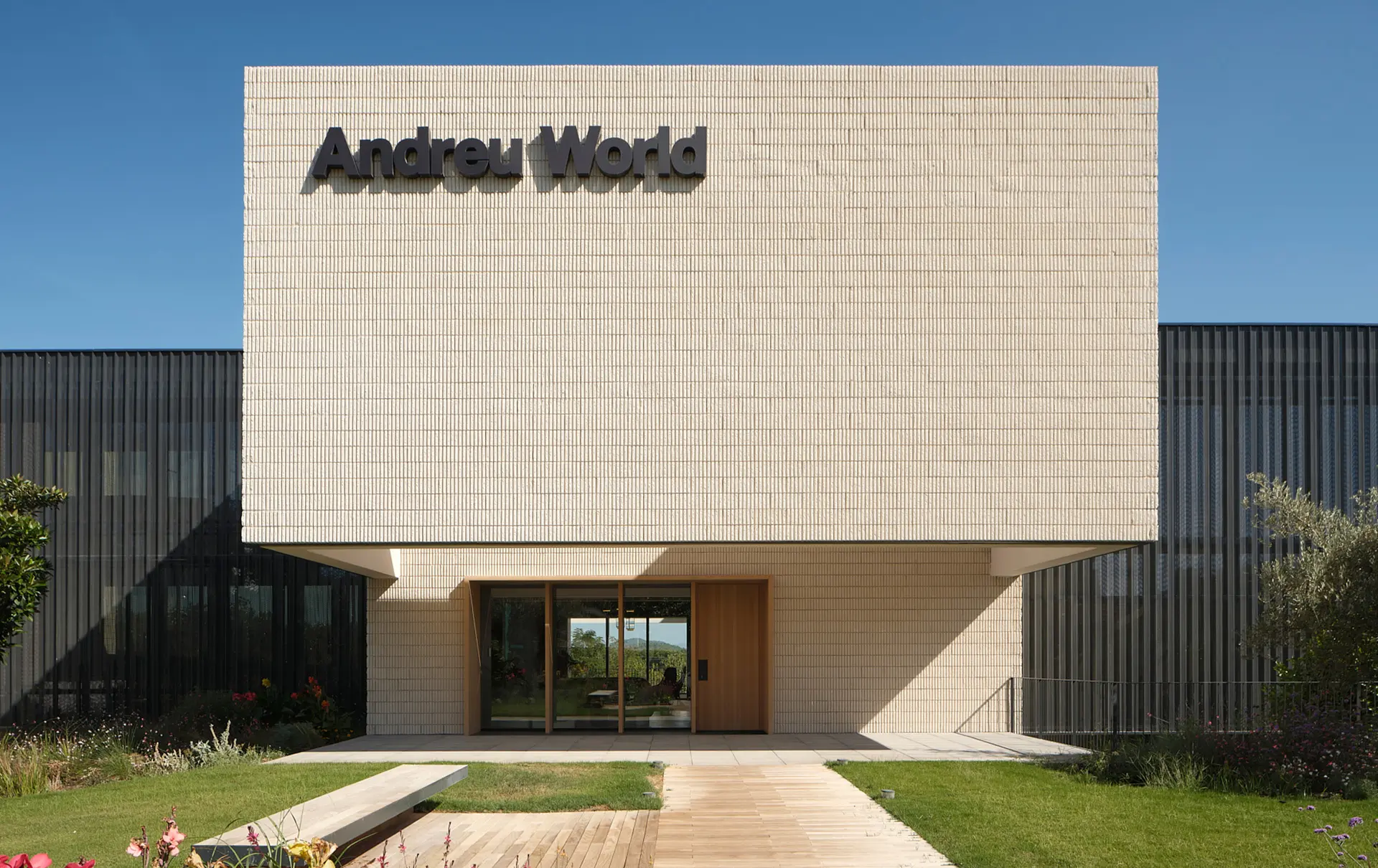
ERRE designs the office and showroom expansion project for the new Andreu World headquarters in Valencia.
Client
Founded in 1955, Andreu World is a global family-owned brand recognized as the first in the furniture industry to certify its entire product catalog under the cradle-to-cradle standard for the circular economy

STRATEGY
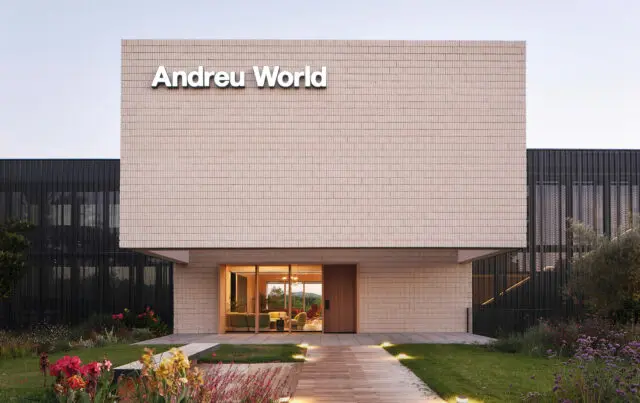
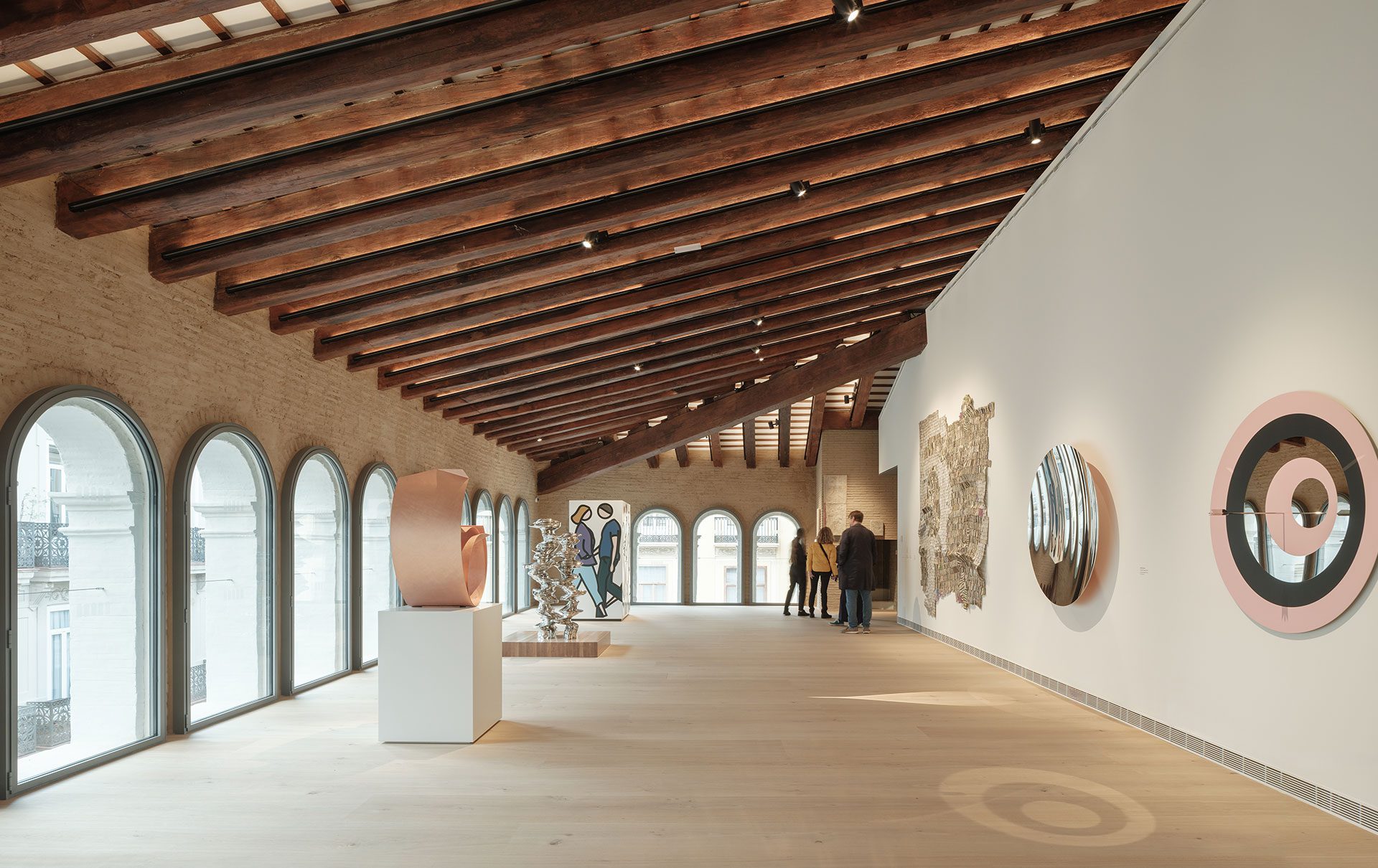
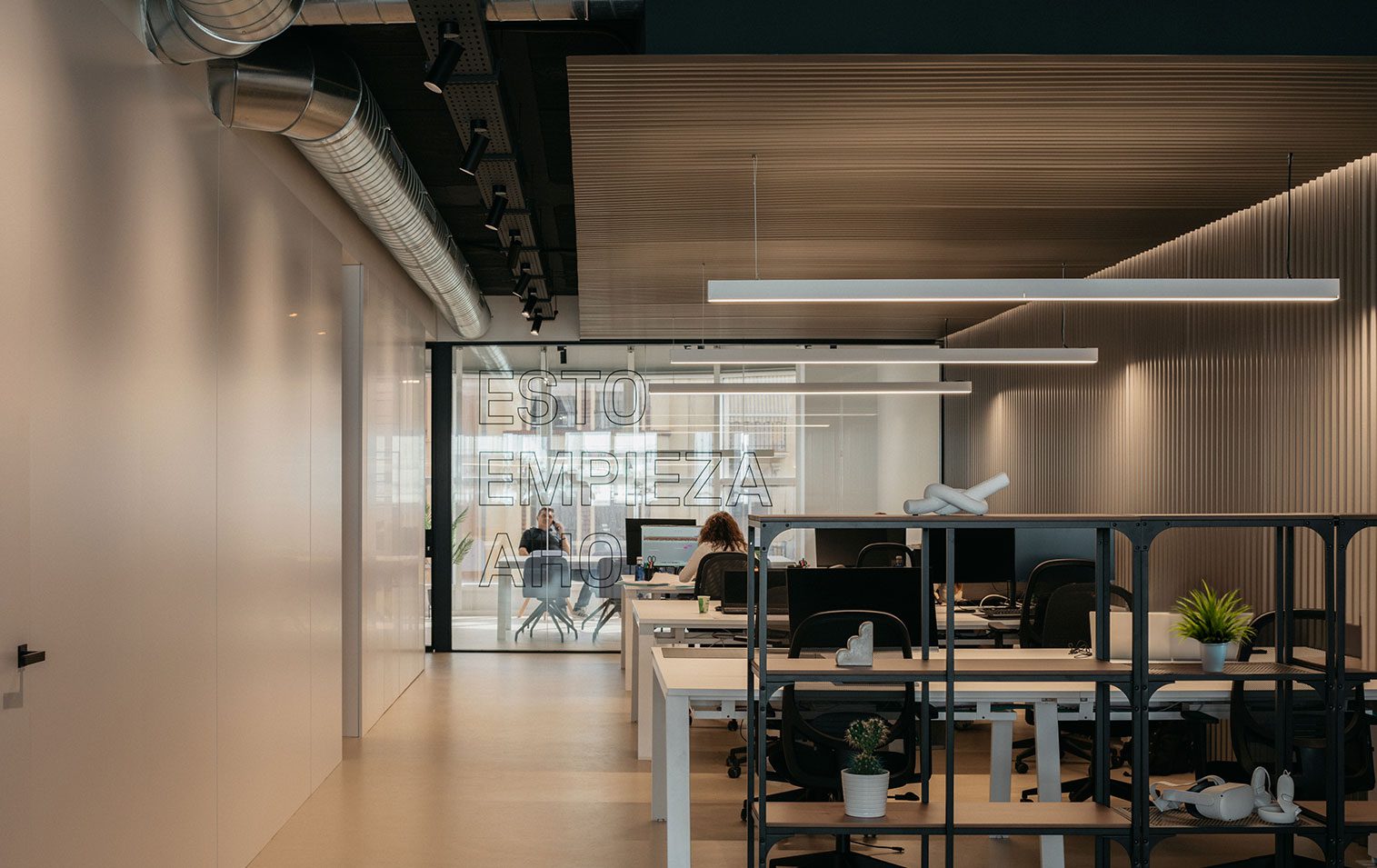
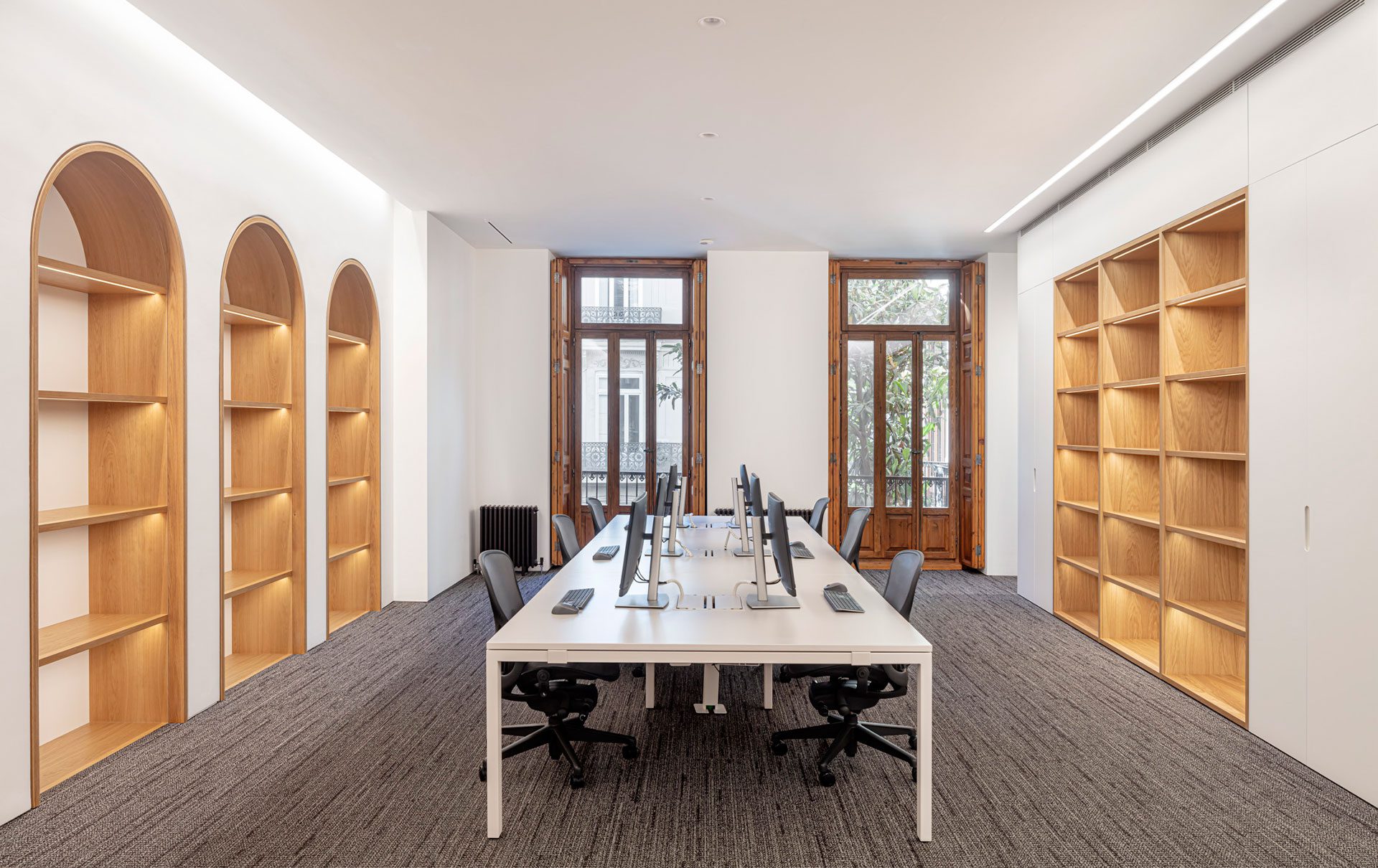
The renovation and expansion project for the Andreu World headquarters in Valencia architecturally interprets the principles that define the brand: versatility, functionality, and sustainability. As part of its 70th anniversary, ERRE is developing the expansion of the central offices and the addition of a newly built showroom, located in a strategic area on the outskirts of the city, with direct views of the Sierra de Chiva Municipal Natural Area. The approach follows a dual strategy: on one hand, the intervention on the existing building, focusing on optimizing its envelope; and on the other, the construction of an adjacent volume designated for the showroom. The result is a complex articulated by a series of pure geometric volumes interconnected with one another, extending across the landscaped plot. Its domestic scale, inspired by the residential typology of the surrounding area, encourages integration into the urban context. The new program encompasses a 6,500 m² area distributed across three levels. On the ground floor, a cantilevered hollow volume lends monumentality to the main entrance, leading into the lobby—a double-height space lit by two large windows with views of the garden and the mountains, crossed at the upper level by a walkway connecting the new volume with the existing building. The upper level mainly accommodates offices and private rooms, linked to exterior terraces designed as outdoor work and gathering spaces. Finally, on the lower level, English patios enhance the natural lighting of additional exhibition spaces and El Ágora: a conference room extending outdoors, creating a tiered stage enriched by vegetation.
SOLUTION
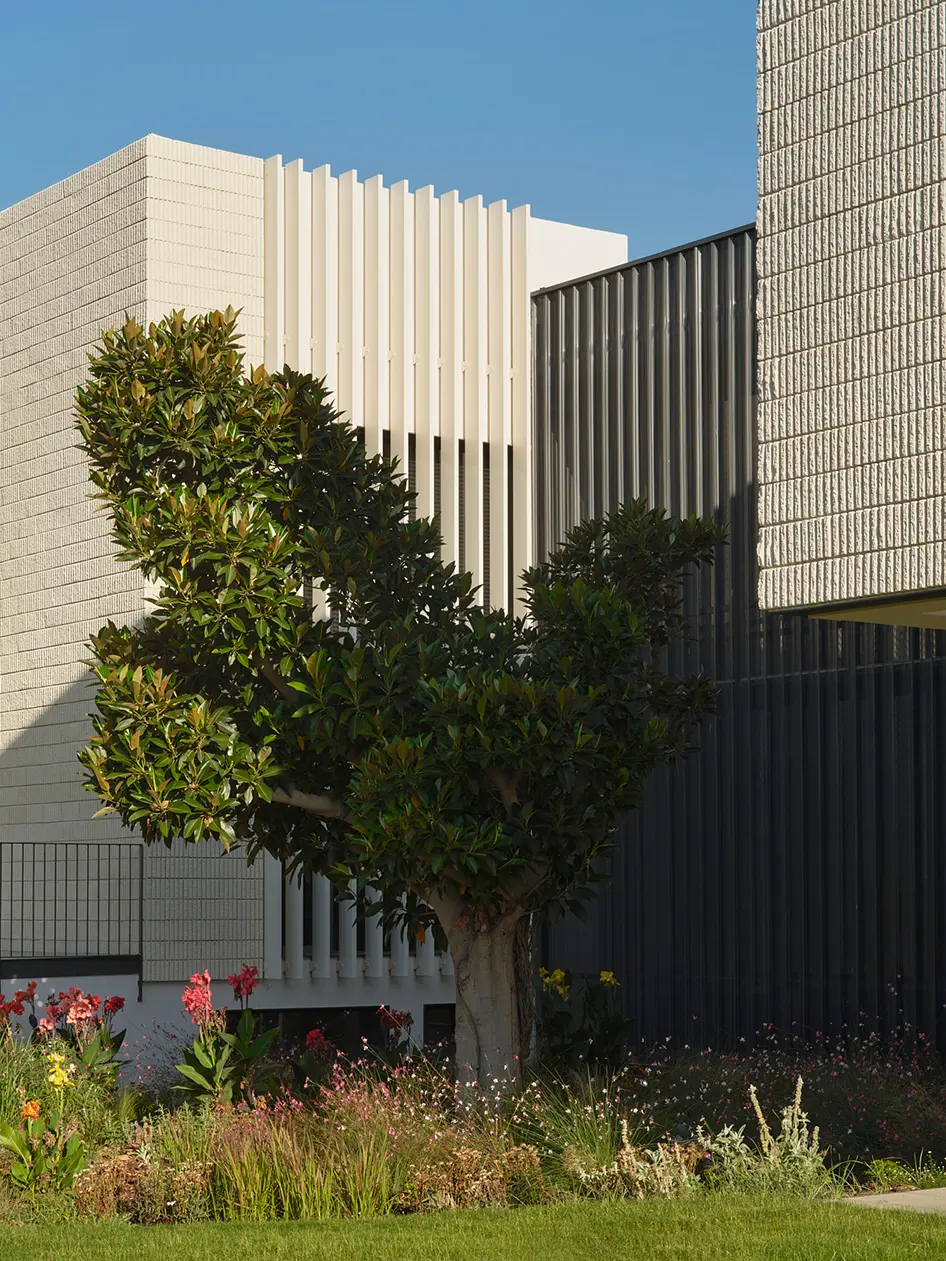
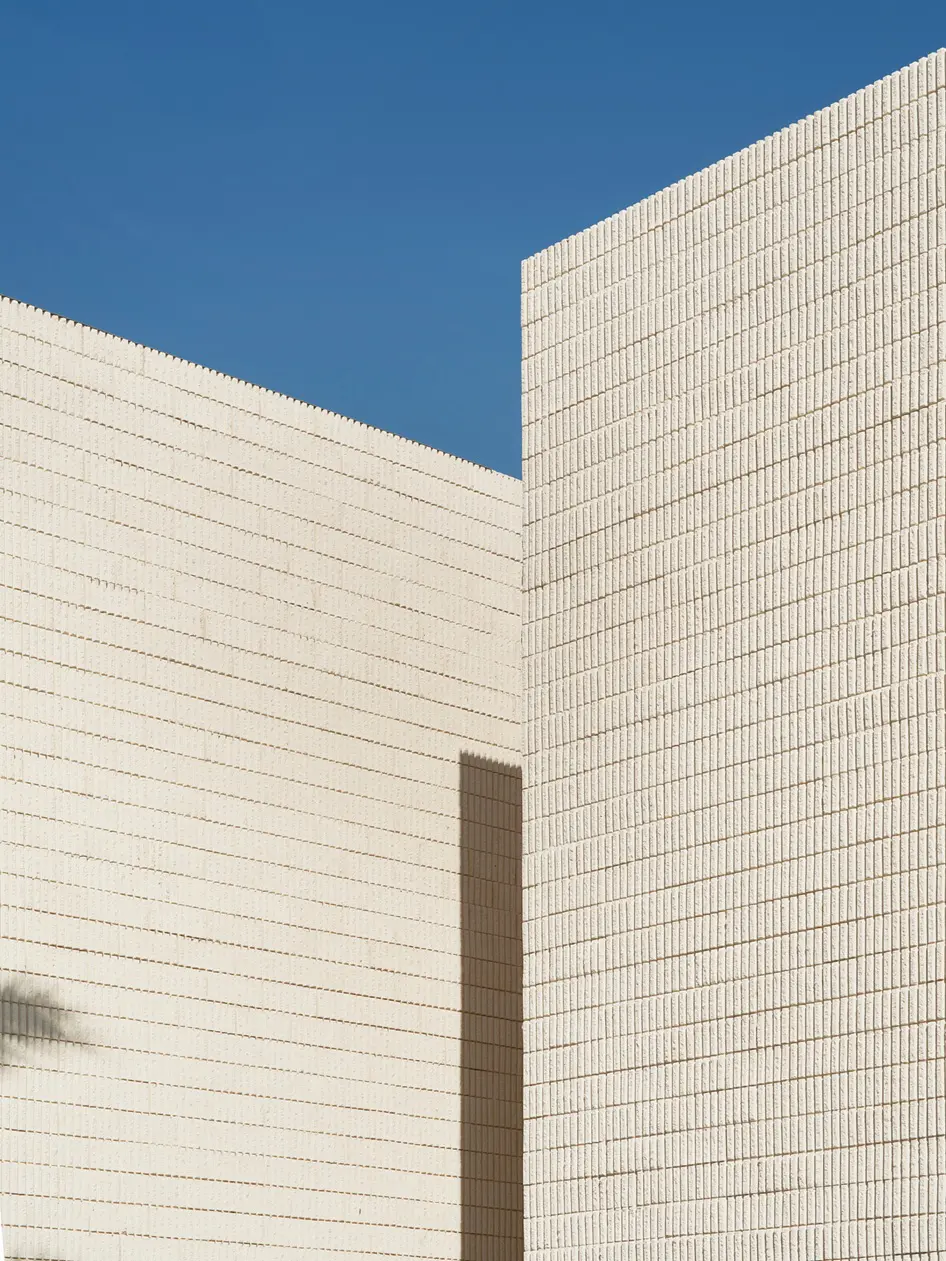
The materiality of the façade is one of the key aspects of the project. The opaque volumes are constructed using Rudolph block, a prefabricated concrete material with a rough texture that brings brightness and an timeless character to the envelope thanks to its raw color. This same material is also used for the cladding of the original building, including its curved wall, creating uniqueness and coherence throughout the complex.
To emphasize the transitions between spaces, these volumes are combined with curtain wall communication cores and translucent micro-perforated sheet metal panels, which provide visual lightness and create rhythm in the façade by contrasting with their dark tone. In the garden, the addition of pergolas allows for the exhibition of outdoor furniture, surrounded by lush native vegetation that structures the landscaping and strengthens the relationship between the interior and the exterior.
Sustainability is at the core of the project’s design, based on a construction model responsible to the environment, materialized through the achievement of the BREEAM certification—one of the most demanding international standards for sustainable building. Among the strategies implemented are the installation of photovoltaic panels on the roof, oriented towards generating renewable energy, and the incorporation of electric vehicle charging points, promoting more sustainable mobility.
The decision to adopt a prefabricated construction system allows for the creation of open, versatile interiors with smooth circulation, ideal for furniture display. Both the beams and the columns are prefabricated, and the slabs are made of hollow core concrete. In the basement, the retaining walls are built with prefabricated reinforced concrete blocks. The hollow volume, suspended at the main entrance, is achieved through a pre-assembled metal truss assembled on-site. All these strategies help reduce emissions associated with the construction process, accelerate execution timelines, and enhance circular economy practices.

Publications
-
2026Spanish Firm ERRE Is Quietly Transforming the City of ValenciaMETROPOLIS
-
2026Andreu World dévoile son nouveau showroom à ValenceA+E MAGAZINE
-
2026La coherencia como enlace entre pasado y presenteTENDECIAS DISEÑO
-
2025La nueva sede de Andreu World en Valencia: arquitectura industrial, paisaje y economía circularARQUITECTURA Y DISEÑO
-
2025Jesús Llinares on Andreu World’s Path to Circular DesignMETROPOLIS
-
2025西班牙家具商Andreu World:瓦伦西亚展示兼办公总部POP OFFICES
-
2025Andreu World Offices and Showroom – ValenciaOFFICE SNAPSHOTS
-
2025Login Signup About us Submit your story Premium mapMapsearchSearch Andreu World Offices and Showroom by ERRE Arquitectura & Francesc Rifé StudioRETAIL DESIGN BLOG
-
2025Beyond the Exhibition: Architecture, Interior, and Landscape as a Single NarrativeARCHDAILY
-
2025NUEVA SEDE DE ANDREU WORLD, VALENCIADISEÑO INTERIOR
-
2025A Valencia, Feria Hábitat 2025 e Textilhogar raccontano il meglio del design spagnolo, con uno sguardo rivolto al futuro e alle nuove generazioniAD ITALIA
-
2025Andreu World celebra 70 años con su nueva sede en Valencia: un showroom de 8.000 m2 que une arquitectura, diseño y sostenibilidadARQUITECTURA Y DISEÑO
-
2025Andreu World fête 70 anys de design durable et de creationA+E MAGAZINE